
Reading Habits in Malaysia (2000–2025): Trends, Changes, and Challenges
Reading habits in Malaysia have experienced significant changes between 2000 and 2025, influenced by education policies, digital technology, socioeconomic factors, and cultural shifts. Over this 25-year period, Malaysians have gradually moved from traditional print reading toward a hybrid culture that includes digital reading, social media content, and e-books. However, studies and surveys still suggest that reading for leisure remains relatively low compared to academic reading requirements.
Early 2000s: Low Reading Culture and Academic-Driven Reading
In the early 2000s, Malaysia’s reading culture was widely considered weak, especially in terms of leisure reading. Many studies from that period indicated that Malaysians read primarily for academic purposes rather than for enjoyment. Research based on earlier national literacy surveys suggested that reading levels were low, with Malaysians reading only a small number of books per year on average in the 1990s and early 2000s.
During this time, reading habits were strongly tied to schools and examinations. Students read textbooks, revision materials, and exam-oriented notes rather than novels or general knowledge books. This created a culture where reading was seen as a requirement rather than a lifelong habit.
Mid-2000s to 2010: Gradual Improvement and Government Initiatives
From the mid-2000s, Malaysia began introducing stronger literacy campaigns and educational reforms to encourage reading. Programs such as national reading campaigns, school library improvements, and public library expansions were introduced to nurture reading habits among students and the public.
Research during this period suggested some improvement. One study indicated that reading levels increased from very low figures in the 1980s and 1990s to around a few books per year, and later improved further to around 8–12 books annually by the mid-2000s in some reports.
However, despite these improvements, reading for pleasure remained limited. Many Malaysians still associated reading with academic pressure rather than leisure or personal development.
2010–2019: Rise of Digital Media and Decline in Deep Reading
Between 2010 and 2019, Malaysia experienced a major shift due to the rise of smartphones, social media, and online entertainment. This period marked a turning point in reading habits.
While access to information became easier through digital platforms, attention spans for long-form reading appeared to decline. Many Malaysians began consuming short-form content such as social media posts, news summaries, and videos instead of books.
Some academic studies during this period suggested that a large portion of Malaysians did not maintain consistent reading habits, with reading often limited to exam preparation or work-related needs.
At the same time, digital reading began to grow slowly. E-books and online articles became more common, especially among university students and professionals. However, this did not fully replace traditional book reading.
2020–2025: Digital Reading Growth and Changing Definitions of Reading
The period after 2020 shows the most significant transformation in reading habits due to rapid digitalization and the impact of the COVID-19 pandemic. During lockdowns, many people turned to digital reading platforms, e-books, and online educational content.
A national reading survey conducted in 2022/2023 reported that Malaysians now read an average of about 24 books per year, combining both print and digital formats (16 printed and 8 digital books). This shows a clear increase compared to earlier decades.
However, the definition of “reading” has also expanded. Modern surveys often include not only books but also digital articles, online news, and educational content. This makes reading rates appear higher, but it also raises questions about the depth of reading engagement.
Recent studies also show a gap between academic reading and leisure reading. While students frequently read for school purposes, many do not read regularly for enjoyment.
Additionally, digital devices have become the dominant reading medium for younger Malaysians. Many students now prefer reading on smartphones or tablets rather than printed books, due to convenience and accessibility.
Current Situation: A Mixed Reading Culture
By 2025, Malaysia’s reading culture can be described as mixed and transitional. On one hand, literacy rates are high, and access to reading materials has improved significantly. On the other hand, deep reading habits—especially reading books for leisure—remain inconsistent.
Some key trends include:
High academic reading among students, but limited leisure reading
Growing digital reading habits, especially on mobile devices
Decline in traditional bookstore usage, with more reliance on online platforms
Uneven reading culture across states and communities
For example, national surveys show differences in reading habits between states, with some regions reporting higher engagement than others, reflecting socioeconomic and educational differences.
Challenges Affecting Reading Habits
Several factors continue to influence reading habits in Malaysia:
Digital distractions – Social media, streaming platforms, and gaming compete with reading time.
Book accessibility and cost – Printed books can be expensive, limiting access for some groups.
Home reading environment – Studies show that children with more books at home tend to read more frequently.
Academic pressure – Students often read only to pass examinations rather than for enjoyment.
Declining library engagement – Some public libraries face challenges in attracting consistent users.
Efforts to Improve Reading Culture
Despite challenges, Malaysia continues to promote reading through various initiatives:
National reading campaigns and “Decade of Reading” programs
School-based reading initiatives and library programs
Collaboration between educational institutions and publishing agencies
Expansion of digital libraries and e-reading platforms
These efforts aim to build a more sustainable reading culture that balances both print and digital formats.
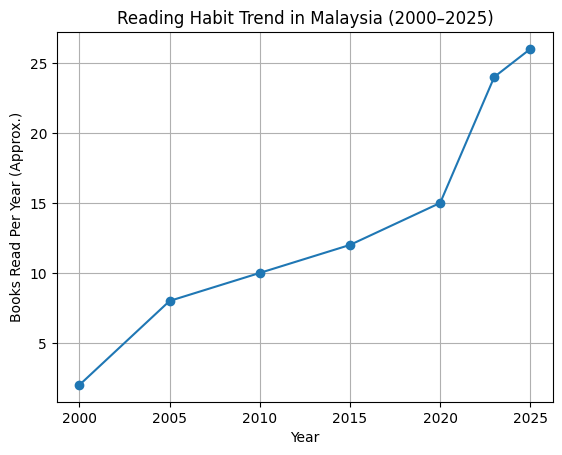
From the graph, we can observe several important patterns:
In the early 2000s, reading habits were relatively low, with Malaysians reading only around 2 books per year on average. This reflects a period where reading was mainly academic and not a common leisure activity.
Between 2005 and 2015, there is a steady increase. This period reflects government literacy campaigns, improvements in education, and better access to books through schools and libraries. Reading slowly became more common, reaching around 10–12 books per year.
From 2020 onwards, the trend shows a sharper increase. This is strongly influenced by digital reading platforms, e-books, and the COVID-19 pandemic, which encouraged people to spend more time with reading materials at home. By 2023, reading levels are estimated to reach around 24 books per year.
By 2025, the trend continues upward, showing a more hybrid reading culture where Malaysians read both printed and digital materials more frequently.
📖 Key Insight
Overall, the graph suggests that Malaysia’s reading culture has improved significantly over 25 years, shifting from a low-reading society to a more active and digitally connected reading population.
However, it is also important to note that much of this growth is influenced by digital reading, and the depth of traditional book reading still varies across different age groups and regions.
Conclusion
Between 2000 and 2025, Malaysia’s reading habits have evolved from a low, exam-focused culture into a more digital and hybrid reading environment. While the number of people engaging in reading activities has increased, the depth and consistency of reading—especially for leisure—remain challenges.
The future of reading in Malaysia will likely depend on how effectively society encourages reading as a habit, not just a requirement. With the right balance between digital innovation and traditional reading culture, Malaysia has the potential to develop a stronger and more meaningful reading society in the years ahead.